Releasing Your Need To Please: Escaping Romantic Relationships with Narcissistic Womenby James ButlerPublished by Wood Dragon BooksReview by Shelley A. Leedahl$21.99 ISBN 9781990863301 I wanted to review Releasing Your Need To Please: Escaping Romantic Relationships with Narcissistic Women because of the premise. It’s unusual, in my experience, to read about female narcissism, but Saskatoon counsellor and author James Butler writes that there’s a “growing phenomenon of women who perpetuate narcissistic abuse.” The men they’re in relationship with are the “pleasers,” and Butler says the only way for a pleaser to live a happy, healthy life is to leave the narcissistic relationship. “If … you are looking for help to escape your toxic relationship, this book is definitely for you,” the disclaimer states. The self-help book’s purpose is “to offer information about how to get out of unfixable, unsustainable, dangerous relationships.” Pleasers must break the “never-ending cycle” of “manipulation and accommodation,” once and for all, and Butler advises them to “lawyer up before [they] plan to escape.” It can be a “disease to please.” Narcissists and pleasers attract one another because of a deep need for love and acceptance that, Butler maintains, they didn’t get enough of as children. He speaks…
The Wind and Amanda’s CelloWritten by Alison Lohans, Illustrated by Sarah ShortliffePublished by Shadowpaw PressReview by Shelley A. Leedahl$23.99 ISBN 9781998273157 It’s been such fun watching Regina author (and musician) Alison Lohans successfully focus her literary talents in so many different directions. The well-known multi-genre author has just released her 31st book, and it’s a standout among the many children’s books that cross my desk each year. Firstly, Lohans knows how to tell a story—whether it’s a novel for young adults, an early-reader chapter book or an illustrated children’s book like her recent release, The Wind and Amanda’s Cello—and it begins with language. In the opening spread of this colourful softcover, we read that “the wind grew restless.” Personification is effective in all writing, but perhaps particularly so when a writer’s engaging young readers. Sound is the most critical element in this book, and Lohans writes about it like she’s making it—a conductor directing an orchestra. We hearthat life-like wind as it “whooshed by cars on the highway; it rattled gates and scattered old leaves on the sidewalk.” Note how the author uses specific details—another hallmark of quality writing. The wind is indeed a powerful character in this story, and…
The Salmon Shanties: A Cascadian Song Cycleby Harold RhenischPublished by University of Regina PressReview by Shelley A. Leedahl$19.95 ISBN 9781779400154 I was excited to read BC poet Harold Rhenisch’s The Salmon Shanties: A Cascadian Song Cycle, as I know him to be a respected writer working in various genres—including fiction, nonfiction and memoir—and his poetry’s been recognized with several awards. The latest of his thirty-three books swims upstream with salmon through Cascadia’s rivers, sings the songs of history as experienced by the English and Chinook Wawa, laments how humans have abused this earth and each other, and praises the natural world and its creatures, from grass to mountains to sky. The poems, scored mostly in couplets, are detail-rich and I recommend reading them slowly to savour the language, names and ideas. It’s also helpful to read them in tandem with the author’s notes on the poems and his extensive glossary of Chinook Wawa—a blended language “of trade and diplomacy … as developed by the wives of traders at Fort Vancouver on the Columbia River” that was commonly used across the Pacific Northwest. In naming these poems shanties (songs), one can rightfully expect that they’re musical. Readers hear grasshoppers “click-clacking in…
Soulworm by Edward WillettPublished by Shadowpaw Press RepriseReview by Shelley A. Leedahl$22.99 ISBN 9781989398807 I missed it the first time, but what’s old is new again—Aurora Award-winning author Edward Willett’s YA fantasy novel, Soulworm, has been auspiciously re-released. What a treat to read the book that launched the prolific Regina writer’s impressive career in 1997, especially as I’ve so enjoyed his subsequent books. And prolific is an understatement: the heralded author, publisher, podcaster, actor and singer has written more than sixty books, including science fiction and nonfiction titles. The opening scene of Willett’s new and revised edition immediately pulled this reader in: it’s 1984, near Weyburn, SK, and seven paragraphs into the story, three teens are in a horrific car accident. After the “car rolled six times in a welter of mud and water, tortured metal, and breaking glass,” it landed upright, and, hauntingly, Van Halen was still “blasting, the thump of the bass like a club pounding the ground.” Exceptional writing. And that’s what one can expect from this seasoned writer, all the way through this adrenaline-charged tale. The story’s simultaneously old-school otherworldly—complete with torches, a tower and drawbridge—and rooted in Earthly details. Sixteen-year-old Liothel is an “Acolyte” in…
Standstill: A Hopewell Earthworks Daybook and Other Essaysby Bruce RicePublished by Long Road PressReview by Shelley A. Leedahl$20.00 ISBN 9781068949708 I’ve long admired the breadth of Bruce Rice’s sophisticated poetry, and now, with the publication of Standstill: A Hopewell Earthworks Daybook and Other Essays, I can attest that his creative nonfiction is equally diverse—and even more satisfying. In his new five-part collection, Saskatchewan’s former Poet Laureate explores various types of language and arts’ life-saving abilities; presents a poetic and sensitive travelogue as he crosses the border to explore the 2000-year-old Hopewell Earthworks (sites aligned with the lunar standstill, long sacred to Indigenous peoples); and transports us to the ICU-bedside vigil for his deaf sister in Nova Scotia. This award-winning Regina scribe—oft-praised for his painterly use of light and shadow—continues to raise the bar with poetic evocations of these elements, as well. Rice explains that “the prairie creature in [him] is drawn to the farthest edges of a place,” and a 2012 trip to Scotland’s Isle of Lewis, Outer Hebrides to appreciate the Standing Stones of Callanish sparked his desire to experience one of the “three known Native American standstill sites.” These journeys are pilgrimages, and the writer treads carefully: what…
Realiaby Michael TrusslerPublished by Radiant PressReview by Shelley A. Leedahl$20.00 ISBN 9781998926039 As a longtime reviewer, I occasionally receive a book that I quickly discern will require disproportionate time and patience to digest. If, for example, I don’t know what the title means—ie: Realia, by award-winning Regina poet and nonfiction writer Michael Trussler—I can expect that Google’s going to be my friend. In a review of Trussler’s The History Forest, I suggested that reading his complex work is “like walking through a forest under the cape of night”. I’m still mostly in the dark with his latest work, Realia, but surmise that this very perplexity is indeed the point. Non-sequiturs, unfinished lines, seemingly random symbols, footnotes, bizarre juxtapositions (“History = milkshake duck”) … colouring outside the lines is this writer’s style, and he’s nothing if not consistent. I needed to take a deeper dive. Trussler’s bio reveals that he’s “neuro-divergent,” and there are references to “phobic anxiety,” “OCD,” and “the psych ward [he] spent a week in downtown”. As I toddled through the pieces—frequently stopping to research names and words—and realized that much of what the poet questions is actually reality, I began to fall under the work’s strange spell…
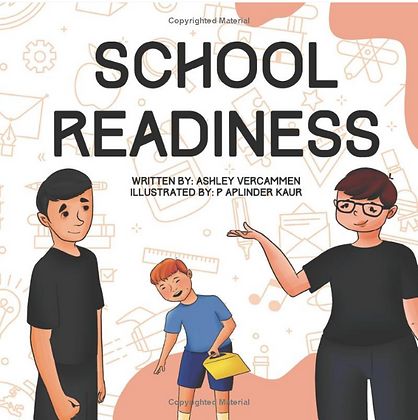
School Readinessby Ashley Vercammen, Illustrated by P Aplinder KaurPublished by Home Style TeachersReview by Shelley A. Leedahl$25.00 ISBN 9781778152993 Ashley Vercammen’s illustrated softcover, School Readiness, is—as the title clearly states—a book about prepping children for their first days of school, and sharing the story with new students could well ease the jitters that sometimes accompany this transition. The writer is a Registered Behavioural Technician (RBT) and her book “is based on the proven techniques of the School Readiness program at Saskatchewan Behaviour Consulting,” where specialists work with families of children with Autism Spectrum Disorder (ASD), Down Syndrome and other developmental disabilities. Vercammen also holds a BA in International Studies from the University of Saskatchewan, and taught English to students in China. The Redvers, SK-born writer’s education and interests have informed the text in School Readiness, published by Home Style Teachers. The book follows a culturally and ability-diverse group of students as they consider how to conduct themselves at school, ie: how one uses a “quiet, inside voice” in the classroom, and how students should raise a hand “to speak or leave [their] chair”. There’s information here for students who might be anxious about school structure, as well, ie: scheduling. “I…
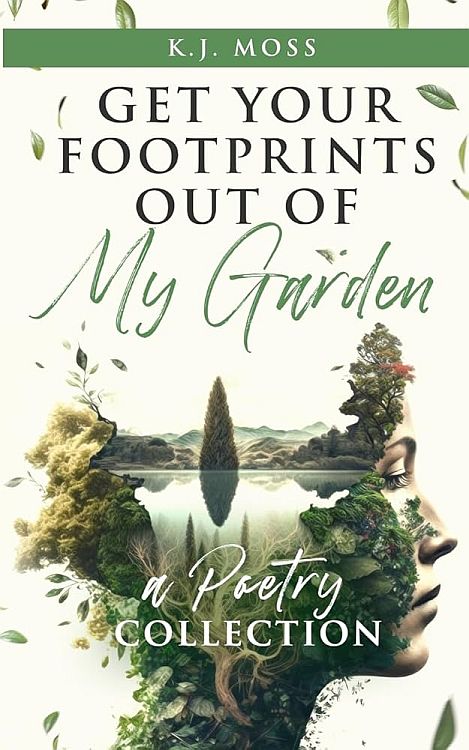
Get Your Footprints Out of My Gardenby K.J. MossPublished by Wood Dragon BooksReview by Shelley A. Leedahl$19.99 ISBN 9781990863509 Poetry can sometimes be obscure and leave readers feeling that they just don’t “get” the work, and thus, they’re unable to connect with it. No one could accuse Moose Jaw resident Karran Moss, a longtime Registered Massage Therapist and new poet, of writing ambiguous work: the poems in her fifty-piece collection, Get Your Footprints Out Of My Garden, are clear-eyed, plain-spoken and easily understandable. Moss explains in her introduction that at age twelve, during a Grade Seven school trip, she was “trapped in an elevator with a predator.” Further trauma occurred when a “well-meaning group of people” tried “to ‘pray’ the trauma out of [her],” which served only to exacerbate her PTSD: “religion became a trauma trigger,” she writes, and this collection is her “journey of growth and healing.” During therapy, “these poems started flying out of [her] soul.” As she continued working on her diagnosed c-PTSD (Complex Post Traumatic Stress Disorder) with a psychologist, the healing began. The tone and “frenzy” of the poems changed, and her “life started to make sense.” The vulnerable and hopeful meditations are organized into…
The Medicine Chest: A Physician’s Journey Towards Reconciliationby Jarol BoanPublished by University of Regina PressReview by Shelley A. Leedahl$29.95 ISBN 9780889779730 I was expecting an academic text when I received The Medicine Chest: A Physician’s Journey Towards Reconciliation by Regina-raised-and-returned-to physician and educator, Dr. Jarol Boan, but immediately discovered there’s nothing dull about this engaging, well-researched and important book. In fact, I flew through it. Boan, an internist who spent twenty years practising and teaching in the US, returned home in 2011—at fifty-seven—to find “Indigenous people played a different role in Saskatchewan’s affairs than they once had,” and this book documents her poignant experiences while treating Indigenous patients within Saskatchewan’s health care system from 2011 to the present. Her accounts are balanced between compelling anecdotes about patients in Regina and on reserves in the Touchwood Hills, other healthcare workers, the system (ie: fee-for-service) and politics; and medical history (ie: the TB epidemic), research and statistics. A few details about Boan’s own personal history (ie: challenging divorce and custody battle) are included, but the true focus concerns the inequities, oppression and racism inherent in the Canadian health care system. Moreover, she explains how she and a few others in the healthcare…
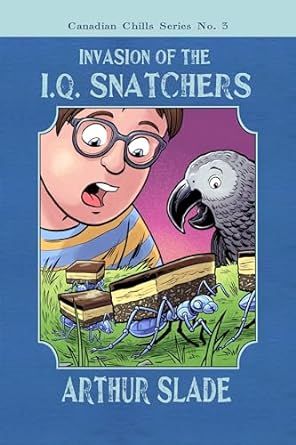
Invasion of the I.Q. Snatchersby Arthur SladePublished by Shadowpaw Press RepriseReview by Shelley A. Leedahl$14.99 ISBN 9781998273041 The Canadian Chills Series is a trifecta of amusing middle-grade novels created by Saskatoon’s award-winning Arthur Slade, and I’ve just devoured the Nanaimo Bar-themed Invasion of the I.Q. Snatchers, the third book in the series. As with his earlier books, Slade’s chosen two clever and curious friends—Gordon Whillickers and Sophia Morrison—to team up against a threatening force, and futuristic technology, an amiable Sasquatch, and bizarrely-behaving adults are part of the package. It’s a recipe that works as well as combining custard, a chocolate ganache topping, and a coconut crumb base. Coastal Nanaimo’s the setting for Slade’s slightly clumsy and seriously science-minded pair. The novel begins thus: “A long, hairy arm reached through my open window and pounded around the top of my desk”. Meet Cheryl, a pink-fingernailed Sasquatch. She’s after the Nanaimo bars someone’s left on the Whillickers’ doorstep, and Gordon has yet to sample. His sassy talking parrot, Archimedes—who’s been listening to “ornithopetic IQ-raising songs” on an MP3 player (this reprinted book initially hit shelves in 2007) and is velcro-strapped into a tiny helmet with a bird cam—takes an investigative flight over…