Art of Immersive Soundscapes Edited by Pauline Minevich and Ellen Waterman Published by University of Regina Press Review by Shelley A. Leedahl $39.95 ISBN 9-780889-772588 Music, laughter, the rustling wind: sound enriches our lives. Of course it can also work the other way, as anyone with belligerent neighbours can attest. Sound is an interesting field of study for scientists and artists. I’d never heard of “immersive soundscapes,” and was curious to learn what they are, why they matter, and who’s creating them. Enter editors Pauline Minevich (associate professor in the Department of Music, University of Regina) and Ellen Waterman (dean of the School of Music and professor of musicologies at Memorial University of Newfoundland), who collected the disparate papers presented at the 2007 international conference “Intersections: Music and Sound, Music and Identity,” held in Regina, and published them and a DVD of the presenters’ audio and video explorations with sound in the book Art of Immersive Soundscapes. Combining science and art, rural and urban, nature and technology, macro and micro, the featured composers in this book show us a fresh and interesting way to experience and understand our social and physical worlds. The interdisciplinary “soundscape movement” began in the 1960s…
Convictions by Judith Silverthorne Published by Coteau Books Review by Shelley A. Leedahl $16.95 ISBN 9-781550-506525 I’ve now read enough of Judith Silverthorne’s numerous books to know that anything she writes will be a worthy read, and my belief was confirmed again with her latest, the historical novel Convictions. This time the multi-award-winning Regina writer (and Executive Director of the Saskatchewan Writers’ Guild) has penned an action-packed, fact-based tale about 14-year-old Jennie, a British lass sentenced to serve seven years in a penal colony in Van Diemen’s Land (Tasmania, Australia) after she was ungenerously convicted of theft. First however, Jennie must survive the four or five months of sailing on a convict ship with 234 other women and children, and a crew that includes more than a few letches. It’s cramped, filthy, and there’s precious little food or medical aid. Before long Jennie finds herself stitching up a fellow convict, Lizzie, a “doxie” who’s been flogged almost to death by the evil guard Red Bull. I’m in awe of how Silverthorne pulls it all together: the historical and sailing details, the adventures (including fistfights, a hurricane, and a shipwreck of Titanic proportions), and even the first sparks of a romance…
Ceremony of Touching by Karen Shklanka Published by Coteau Books Review by Shelley A. Leedahl $16.95 ISBN 9-781550-506679 It’s gratifying to possess some knowledge of where, both literally and metaphorically, a poet is writing from. The first piece in BC poet/doctor/dancer Karen Shklanka’s second book of poetry – which originated as her master’s thesis – is a touchstone. It introduces us to “the wounded soul of a doctor” who finds repose on Salt Spring Island among the “scent of salted forest, wrap of humidity/from logs returning to earth, and reassurance/from thickets of salal flowers cupped in prayer.” It’s a strong, unique, and elemental premise. In many ways I feel this seven-sectioned book is not unlike one long prayer, or at least a meditation: upon one’s profession, personal relationships, nature and human nature, how “everything is connected,” and upon the atrocity of the atomic bombing of Hiroshima. The section that recounts the historical event (from a fictional tailgunner’s perspective; I’m thankful for the poet’s extensive notes on the poems) is titled “Flight Log,” and it’s no small deal that it was long-listed for the CBC Poetry Prize. More interesting to me, however, are the numerous poems in which one can almost…
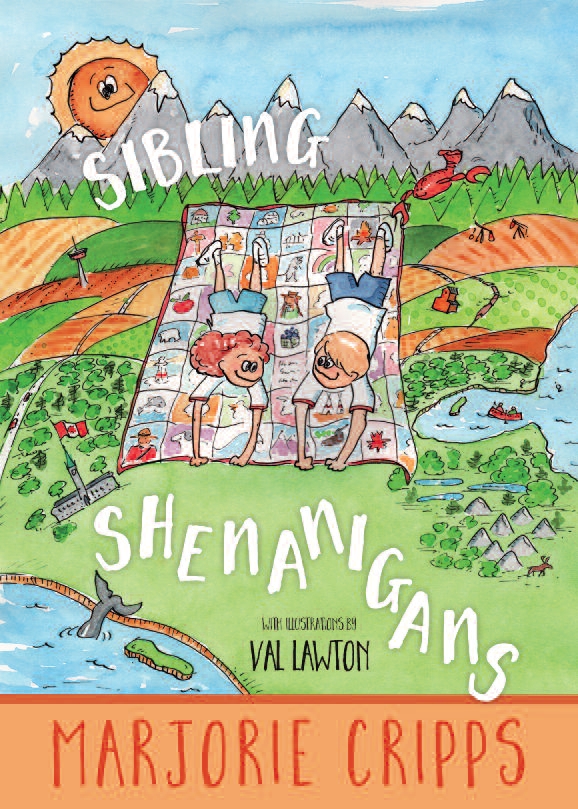
Sibling Shenanigans by Marjorie Cripps, illustrated by Val Lawton Published by Your Nickel’s Worth Publishing Review by Shelley A. Leedahl $12.95 ISBN 9-781927-75706 I can’t imagine a better title for first-time author Marjorie Cripps’ collection of stories for young readers than what she’s chosen, Sibling Shenanigans. This fun and ably-written series of short tales features likeable siblings Amanda and Mitchell, who get along exceptionally well with each other, their parents, and their beloved Grandma. The senior’s a central character (and sometimes accomplice) in several of the ten pieces. Saskatchewan-born Cripps is a retired school librarian whose love of quilting is evident in many of the stories. Using different styles – some stories are written in First Person, others in Third Person; some are realistic, others fantastic – and an upbeat tone, Cripps welcomes us into the active lives of young Amanda and Mitchell, beginning with the latter’s spectacular adventure in a “runaway stroller”. Cripps shares anecdotes about sleepovers, birthdays, Christmases, pet dogs, camping, and a family move from one side of Vancouver to the other. I appreciated how easily the author’s pen swung between real life and fantasy, making both feel credible. In “Barkley on Wheels,” we learn that Grandma…
Shaping a World Already Made: Landscape and Poetry of the Canadian Prairies By Carl J. Tracie Published by University of Regina Press Review by Shelley A. Leedahl $27.95 ISBN 9-780889-773936 The respectful and sweeping premise for Shaping A World Already Made – the brainchild of author/cultural geographer Carl J. Tracie – is to “make meaningful observations about the interconnected themes of poetry, landscape, perception, paradox, and mystery on the [Canadian] prairies.” In his examination of the poetry of place, Tracie seeks to view the prairie landscape “through the lens of poetry,” and asks how the physical elements impact on poets and their work, and how their representation of the landscape influences readers’ (“residents and outsiders”) vision of this land. A self-professed fan of poetry, rather than a poet himself, Tracie analyzed the work of nine “prairie” poets (they might not currently live on the prairies, but their work demonstrates “a long attachment” to it), including Di Brandt, Lorna Crozier, John Newlove, Tim Lilburn, and Eli Mandel, and found commonalities and differences in their subjects, sentiments, and styles. He also refers to the work of a number of Indigenous poets, including Louise Halfe and Marilyn Dumont. Why would a cultural geographer…
My Good Friend, Grandpa Story by Elaine Sharfe, Illustrations by Karen Sim Published by Your Nickel’s Worth Publishing Review by Shelley A. Leedahl $9.95 ISBN 9-781927-756713 You don’t have to be a grandparent to appreciate Saskatoon writer Elaine Sharfe’s illustrated children’s book, My Good Friend, Grandpa. Indeed, anyone with a heart will adore this beautifully-rendered tale about a boy’s strong connection with his beloved grandfather, and, as in all the best writing, the author skillfully evokes emotion without regressing into sentimentality. Want to write your own children’s book? Reading and studying great books is the best way to learn, and I’d definitely recommend Sharfe’s well-written story to anyone who has an emotional children’s story to tell. The tenor is spot-on here. Sharfe starts and ends on just the right notes, immediately establishing the characters’ close relationship by simply stating it: “Noah and Grandpa Ed had been good friends for as long as Noah could remember. Grandpa Ed said they had been friends forever.” Nanaimo illustrator Karen Sims ably demonstrates this tight bond via full-colour images that show the young, big-eyed boy and his loving grandfather involved in activities that range from watering plants at the family cottage to enjoying treats…
The Sky Was 1950s Blue Written by Katherin Edwards, Design by Melissa Haney Published by Jackpine Press Review by Shelley A. Leedahl $30.00 ISBN 978-1-927035-22-1 Jackpine Press recently released The Sky Was 1950 Blue-a collaborative chapbook written by Katherin Edwards and designed by Melissa Haney-and I received #51 of a limited edition of 75 copies for review. Limited edition, handmade books are Jackpine’s foray, and each time I receive one I’m excited to see how the author and designer-often one and the same-have reconciled content and construct: concepts are such interesting animals. Edwards’ colourful title comes from an Ian Tyson lyric, and the 1950s are represented here not only in the saddle-stitched book’s hue and interior drawings, but also in the fact that each poem includes a year (between 1950 and 1959) in its title. I opened the chapbook to discover that it also possesses a subtitle, “Poems from the Clothesline,” and indeed a continuous drawn clothesline acts like a border, stretching across the top of each page and supporting simple drawings of the clothing and linens referenced in each of the thirteen poems. The books were printed via a three hundred year-old process called cyanotype, which involves both “sunning”…
homecoming Written by Zondra M. Roy Published by Jackpine Press Review by Shelley A. Leedahl $30 ISBN 978-1-927035-20-7 Sometimes the lines between genres blur. As I began reading Zondra M. Roy’s chapbook, homecoming, I thought: looks like poetry, feels like a first-person essay. This isn’t poetry filled with similes, metaphors, alliteration, and finely-crafted images, this is a straight-up story (with line breaks) that shouts This is how it’s been, I’ve made mistakes, and I’m grateful for the people and activities (like performing hip-hop) that’ve helped me along the way. The Dené/Cree/Métis writer left home at thirteen and she doesn’t hold back on her life’s gritty details as she writes of bouncing between various homes in Saskatchewan, Manitoba, Ontario, New Brunswick (“for a few months”), and British Columbia. Actually, the word home is a misnomer here–no warm connotations of homemade bread and a family sitting around a fireplace exist when one’s stays include a juvenile detention centre in Saskatoon; jail; and that hardest of beds–the street. Roy begins her story with family history: “My parents were born into a society that was built to facilitate their failures.\well, fuck\they were native people in the northern prairies.” Strong language and a strong voice,…
Lost + Found: Signposts for Steering Through the World by Laura Lamont, Designed by Jess Dixon Published by Jackpine Press Review by Shelley A. Leedahl ISBN 978-1-927035-18-4 $30.00 In 2015, Saskatoon’s Jackpine Press published Lost + Found: Signposts for Steering Through the World, and the good news for the press and the book’s creators is bad news for you, readers: each of the 75 copies of this limited-edition, hardcover (millboard wrapped in craft paper, bound with fabric tape and snapped together with Chicago bolts) has already found a home. Usually one reviews books that are new and available, but it’s also worthwhile to examine a success story, and introduce readers to the writer so they can watch for future works. Let’s begin with this book’s eclectic design. If it were a painting, I’d suggest it’s closet to collage. If it were music, it would be jazz. Inset location diagrams represent individual poems and appear as background to each poem’s text. Imprinted cotton paper; cascading, torn vellum; a post-it-style note (that protrudes outside the book’s neat and expected rectangle); apparent “scrap paper;” and pages that are coffee-cup ringed and wrinkled are all fair game for hosting poems in this little marvel…
Connectomics Written by Alison Calder Published by Jackpine Press Review by Shelley A. Leedahl $30 ISBN 978-1-927035-21-4 Into the laboratory we go: the fourteen poems in established writer and Winnipeger Alison Calder’s Connectomics are like little scientific explosions of light: things you didn’t know you’d want to know but are glad you know now. In her words, “The idea is\to render the brain\transparent enough to read through.” That’s heady stuff, but Calder takes this concept and renders it into thought-provoking poems that show she’s a master of metaphor, and prove that her literary experiments work. The brain as poetic fodder makes good sense. It’s complex, essential. Nerve central. And Calder, who teaches Canadian literature and creative writing at the University of Manitoba, explores it from interesting angles. In “Clarity2” she imagines the mind of a mouse that’s had firefly genes spliced into for Alzheimer’s research. “Inside his skull\the past incinerates” she writes, “fragments\of a film that’s not replayed.” On the page opposite this short poem there’s a white image (on black) of a brain: it looks like a medical image and it resembles art. The subject of the next poem, “C Elegans3,” is “a small, soil-dwelling nematode.” (The accompanying drawing…