Boiling Point & Cold Cases: More Saskatchewan Crime Stories by Barb Pacholik, with Jana G. Pruden Published by University of Regina Press Review by Keith Foster $19.95 ISBN 978-0-88977-286-1 Gruesome, grisly, and ghastly are just three words that might describe some of the crimes in Barb Pacholik’s Boiling Point & Cold Cases: More Saskatchewan Crime Stories. Readers might wonder how some people can treat other humans so brutally. The collection consists of forty stories, thirty-six black and white photos or illustrations, and a list of sources on topics as diverse as Prohibition, marijuana grow-operations, and the Ku Klux Klan in Saskatchewan. Crimes range from shooting, stabbing, bludgeoning, and arsenic poisoning. Some motives are just plain weird. It’s hard to believe someone would kill another human being just to steal his car stereo. One man killed his family because, he said, he loved them so much. The time span ranges from late 19th century to early 21st century, primarily in Saskatchewan and Alberta. The earliest case cited in Boiling Point and Cold Cases occurred in 1885 when John Connor murdered Henry Mulaski in Moose Jaw. Connor was hanged in Regina on the very day that the trial of Louis Riel began….
Cream Money: Stories of Prairie People Compiled and edited by Deana J. Driver Published by DriverWorks Review by Shelley A. Leedahl $19.95 ISBN 978-192757019-7 I didn’t expect this. While reading Cream Money: Stories of Prairie People, I stopped several times and thought: we have no idea. “We” being anyone who did not live in rural SK in the early to mid-1900s, when even children worked hard to ensure that life ran smoothly on the farm. It was the era of large families and tight budgets, of rolling up one’s sleeves before the school bus even arrived, and of smothering foods of all kind in rich, delicious, straight-from-the-cow cream. Editor Deana J. Driver has collected 29 short and interesting anecdotes (plus several black and white photographs) from residents of the prairie provinces of Alberta, Manitoba, and Saskatchewan who well recall how hard they worked and how different life was in earlier times, when cream was regularly sold to creameries. It was not uncommon for farmers of that time to own at least one dairy cow, and the much-needed funds earned selling cream kept many families financially afloat during lean times. Within these pages we learn about specific animals, milking techniques, the…
The Identities of Marie Rose Delorme Smith: Portrait of a Métis Woman, 1861-1960 by Doris Jeanne MacKinnon Published by University of Regina Press Review by Keith Foster $34.95 ISBN 978-0-88977-236-6 Doris Jeanne MacKinnon’s The Identities of Métis Rose Delorme Smith: Portrait of a Métis Woman is an incredible story of a seemingly ordinary woman who lived a remarkable life spanning nearly a century, from 1861 to 1960. In an era when ordinary women often remained unknown, what sets her apart? She lived at a time and place when significant western Canadian history was being made and personally knew many of the historical personalities of the time. She was also well-educated and literate, rare for a Métis woman of that period, and recorded her experiences in a diary. It’s incredible that she overcame all the hardships she did – surviving whooping cough as a youth, being “traded” in 1877, at age sixteen, to a white man more than twice her age for $50, giving birth to seventeen children, and losing two sons in the First World War. According to Marie Rose, her arranged marriage was the result of a misunderstanding. When Charlie Smith, a wealthy whisky trader, grabbed hold of her…
#IdleNoMore: And the Remaking of Canada by Ken Coates Published by University of Regina Press Review by: Justin Dittrick $27.95 ISBN: 9780889773424 In #IdleNoMore: And the Remaking of Canada, Ken Coates examines the Idle No More movement from its understated beginnings in November 2012 to its climax in the late winter of 2013. While Idle No More can be compared to other social movements, such as Occupy Wall Street and the Arab Spring, it differs from them in several important ways. It is these differences that make the movement truly remarkable, including its lack of an official spokesperson, its lack of affiliation with political leaders, mainstream ideologies, and party elites, and its lack of an organizational structure beyond organizers’ commitment to its grassroots origins and inspiration. Indeed a convincing argument can be made that Idle No More contributes a set of best practices for peaceful, exuberant, and community-driven protest. With its energy, direction, and focus coming almost entirely from the public, it is greater than the sum of its actions and events, having galvanized discussion and instilled pride in a new generation of Indigenous Canadians on a wide assortment of issues and challenges to be faced in the coming years….
Metis and the Medicine Line: Creating a Border and Dividing a People by Michel Hogue Published by University of Regina Press Review by Keith Foster $34.95 ISBN 9780889773806 On the open prairies in the 1870s, one could look to the horizon without seeing any distinguishing features. Yet here was the border – an invisible boundary along the forty-ninth parallel – dividing the United States and Canada. The job of the North American Boundary Commission was to make the invisible border visible. They did this by building mounds of sod placed three miles apart – surely a ludicrous situation since anyone standing beside a mound would barely be able to see the next mound even on a clear day. Although “First Nations” doesn’t actually appear in the title of Metis and the Medicine Line: Creating a Border and Dividing a People the book devotes substantial space to their issues as well. Author Michel Hogue sheds light on both Metis and First Nations people and their culture. As the subtitle suggests, the Medicine Line divided not only the two countries, but also the people living there. Hogue points out that Metis and First Nations people were well aware of the power and…
What Do You Do All Day? by Miriam Hoffer Published by Your Nickel’s Worth Publishing Review by Shelley A. Leedahl $21.95 ISBN 978-1-927756-25-6 Before reviewing Miriam Hoffer’s book What Do You Do All Day?: Women’s Stories of Retirement, I considered perceptions of retirement, then realized, through reading, how different perceptions often are from the realities. Do you view retirement as a desert of time? A period of loneliness, failing health, and disconnection from social and intellectual life? If you believe retirement is ”the last sad chapter” in one’s life, prepare to have your perceptions shaken up, for Hoffer-and the 25 women she interviewed about the “retirement journey”-paint a rosy picture of post-employment life. Common to all in this engaging nonfiction book is the sentiment that they “have no trouble figuring out what to do with [their] time.” They volunteer, work out, take classes, travel, provide childcare for family members, and engage in activities ranging from meditation to piano lessons, from clowning to seeing the world. Hoffer, a retired dietitian, says her own launch into retirement was one of “delirious enjoyment”. She viewed it as “a never-ending vacation from obligation.” Several in the book express a dislike of the word “retirement.”…
Women’s History Edited by Wendee Kubik and Gregory P. Marchildon Published by University of Regina Press Review by Keith Foster $34.95 ISBN 9780889773127 The history of women in the Prairies is a story of accomplishment and ongoing struggle – clearly depicted in Women’s History, edited by Wendee Kubik and Gregory P. Marchildon, This is the fifth volume in the History of the Prairie West Series, designed to appeal to a wide audience, from general readers to professional historians. Although Women’s History focuses on the three Prairie Provinces of Saskatchewan, Alberta, and Manitoba, it also extends to the American West. The book includes an array of subjects, including prohibition, vagrancy, suffrage, political activism, and union organizing. Women’s History is divided into six sections – Politics, Law, Agriculture, Labour, Journalism, and Ethnicity – covering the period from the 1870s to 2005. The seventeen analytical essays by fifteen authors were previously published in various issues of Prairie Forum; they are now conveniently located in this one volume. Each section contains essays appropriate to that area, often with intriguing titles such as “Spinsters Need Not Apply: Six Single Women Who Attempted to Homestead in Saskatchewan between 1872 and 1914,” and “25¢ an Hour; 48…
Wilf Perreault: In the Alley Edited by Timothy Long Published by Coteau Books and MacKenzie Art Gallery Review by Courtney Bates-Hardy $59.95 ISBN 978-1-550505955 Wilf Perreault: In the Alley is a stunning coffee table book. The book design itself is enough to tempt anyone into picking it up and buying it. A sizable book at 12” by 10”, it certainly does justice to Perreault’s beautiful and large-scale images, although it’s difficult to top seeing them in person. What the book offers is an engaging and insightful background on Perreault’s life, art, and the many ways he has touched others. In the Alley begins with an introduction by Timothy Long, the head curator at the MacKenzie Art Gallery. He gives a brief overview of Perreault’s childhood on a farm near the French-speaking villages of Henribourg and Albertville. The book, it should be noted, is appropriately presented in both French and English. Long moves from Perreault’s childhood to his time at the University of Saskatchewan and then as a teacher, all the while tracking Perreault’s growth as an artist and the connections he makes within the community. The most fascinating parts of Long’s introduction are the back stories he includes for some…
Downstream: Bestemor & Me by Vangie Bergum Published by Hagios Press Review by Keith Foster $18.95 ISBN 978-1-926710-26-6 In Downstream: Bestemor & Me, Vangie Bergum takes readers on her spiritual journey of self-awakening, self-discovery, and self-empowerment. Through creative non-fiction, she interweaves her own life story with that of her grandparents, peppering her narrative with Norwegian words and phrases, reflecting her ancestral background. While visiting Norway, she ponders why her grandparents left “this verdant land to spend their lives in the dry, treeless, windy spaces of the Saskatchewan prairies.” Her name, Bergum, “means encircled or surrounded by mountains,” and she wonders if this is where she was meant to be. In a twist of fate, the next generation, her mother’s generation, fears “the hovering mountains,” she says. “They claim they can only breathe on the non-stop prairie.” As she explores her Norwegian roots, Bergum uncovers a family tragedy – the deaths of her grandparents and their two daughters. She says the manner of their deaths – murder and suicide – brought shame to her family, “a shame encoded in my life from the time of my conception.” Adding to that shame is the fact that her grandmother spent time in two…
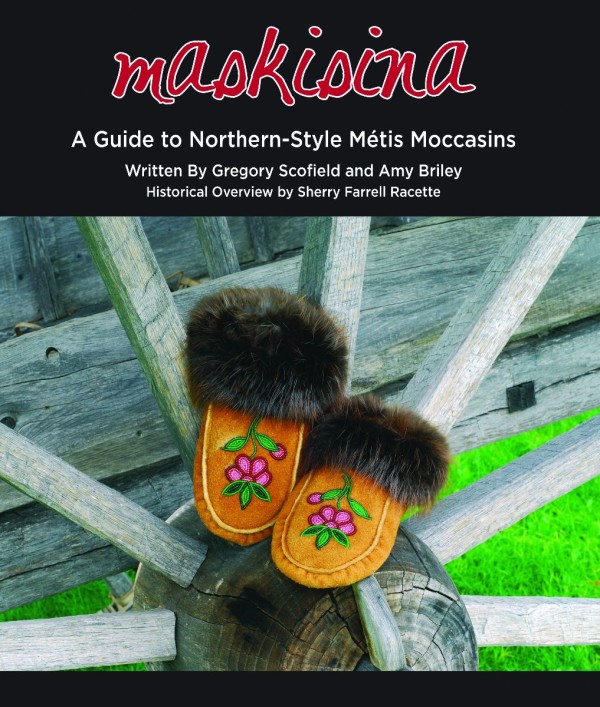
Maskisina: A Guide to Northern-Style Métis Moccasins by Gregory Scofield and Amy Briley, Historical Overview by Sherry Farrell Racette Published by Gabriel Dumont Institute Review by Shelley A. Leedahl $24.95 ISBN 978-1-926795-11-9 Here’s a test for the efficacy of a “How To” book: 1) select one on a subject you have no knowledge of, and perhaps no previous interest in. 2) carefully read it. 3) if said title inspires you to want to do the “How To,” then you’ve just read a successful book. I came to maskisina: A Guide to Northern-Style Métis Moccasins, by Gregory Scofield and Amy Briley, without knowing anything about the subject, though I spent years in northern Saskatchewan. The attractive, coil-bound guide is filled with step-by-step instructions and large photo illustrations that even the uncrafty could easily follow to create fur-trimmed, cuffed, or wrap-around moccasins from home-tanned moose hide or commercially-tanned leather. (Gorgeous beaded “vamps” that cover the forefoot are another skill, and literally, another book; see wâpikwaniy: A Beginner’s Guide to Métis Floral Beadwork, also published by the Gabriel Dumont Institute.) The actual instructions, “Helpful Hints,” and brief anecdotes\advice (ie: “Acknowledge and respect that you are making a connection. The pair of moccasins you…