Metis Soldiers of Saskatchewan
Gabriel Dumont Institute / 19 August 2014

Métis Soldiers of Saskatchewan: 1914-1953 by Cathy Littlejohn Published by Gabriel Dumont Institute Review by Keith Foster $25.00 ISBN 978-1-926795-10-2 They were there – at Vimy Ridge, Dieppe, Ortona in Italy, and Juno Beach on D-Day. In every major campaign of the First and Second World Wars and in a hundred skirmishes in Korea, Saskatchewan Métis soldiers were there, fighting for Canada. Their exploits are chronicled in Cathy Littlejohn’s Métis Soldiers of Saskatchewan: 1914-1953. Métis were readily accepted into the military because they already knew how to handle firearms and often brought certain skills useful in warfare. Littlejohn tells many of the stories in the soldiers’ own words, gleaned from transcripts in the Gabriel Dumont Institute. “My officer asked where I got the jug,” one Métis said, after crawling across no man’s land in the First World War. “I told him that I got it off the Germans in the frontline. He said that I had risked my life and they gave me a medal.” During the Second World War, Métis troops were among those captured when Hong Kong surrendered to the Japanese on Christmas Day, 1941. As prisoners of war, they endured near-starvation. One soldier was so hungry he…

A Country Boy
Hagios Press / 25 July 2014

A Country Boy: From Sussex to the Canadian West by R.D. Symons Published by Hagios Press Review by Keith Foster $17.95 ISBN 978-1-926710-24-2 A Country Boy: From Sussex to the Canadian West is a memoir of an English lad transplanted to Saskatchewan, where he took root and flourished as a naturalist, author, and artist. Robert David Symons came by his artistic talent honestly – his father was a professional artist, and a critical one at that. He called his son’s first painting a “mess” and trampled on it “like one of Kipling’s elephants,” then showed the youngster the proper way to paint. Symons excels at detailed descriptions of prairie life, painting vivid pictures in the reader’s mind: “Coffee bubbled in a granite pot; on the well scrubbed cabinet big, brown loaves steamed, belly upward, cheek by jowl with fragrant pies.” With an artist’s eye, Symons describes one man who “possessed a tremendous acreage of gleaming teeth, and very dark eyebrows, like bits of moleskin pasted on.” His description of a prairie blizzard, resulting in 800 dead or dying cattle, is smack on. Symons enlisted in the Canadian Expeditionary Force during World War I and in one particularly hot battle found…

Swedes’ Ferry
Coteau Books / 14 May 2014

Swedes’ Ferry by Allan Safarik Published by Coteau Books Review by Keith Foster $19.95 ISBN 978-1-55050-561-0 Swedes’ Ferry is a double-barrelled adventure tale, and author Allan Safarik lets loose with both barrels blazing. His novel has a cast of colourful characters, some based on actual historical people like North-West Mounted Police Commissioner Lawrence Herchmer, others fictional but very much imbued with the breath of life. The search for a tall man who robbed a bank in Bismarck, North Dakota, killed the manager, and galloped away on a stolen powerhouse of a horse leads two Pinkerton detectives to Regina in 1894. There they try to enlist the aid of the imperious Herchmer, who proves unco-operative. Their break in the case comes from two attractive “spies” operating in a brothel above a Chinese restaurant. The tall man is aided by Bud Quigley, an astute horse trader, who brokers the deal of a lifetime with James J. Hill, president of the Great Northern Railway and owner of the First National Bank that was robbed. A ferry, operated by two Swedish brothers, plays a pivotal role in the tall man’s attempt to retrieve his hidden stash of $44,000. With a background as a poet,…

Building a Legacy
Coteau Books / 3 April 2014

Building a Legacy: Edmonton’s Architectural History by Ken Tingley, with Lawrence Herzog Published by Coteau Books Review by Keith Foster $39.95 ISBN 978-1-55050-545-0 Every city deserves to have its own coffee table book displaying its heritage structures and architectural marvels. Building a Legacy: Edmonton’s Architectural History is a shining example of how such a book can be organized. This 234-page hardcover book shows Edmonton’s history through hundreds of black and white and colour photos of its buildings. Lawrence Herzog, who has photographed and written about the city’s history for more than a quarter of a century, took many of the photos, supplemented by photos from the City of Edmonton Archives. Author Ken Tingley’s narrative is well-researched and well-written. Each chapter covers a period from the fur-trading days at Fort Edmonton up to the 21st century. He also includes an index and glossary of architectural terms. The book provides basic information on each building, such as its address, date of construction, and date of its designation as an historic resource. Tingley then gives a fascinating narrative background on the buildings and the people involved with them. Tingley notes some of the city’s more colourful characters, and this is where the book…

Fists Upon A Star

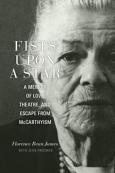
Fists Upon A Star: A Memoir of Love, Theatre, and Escape from McCarthyism by Florence Bean James, with Jean Freeman Published by University of Regina Press Review by Keith Foster $34.95 ISBN 978-0-88977-260-1 “Speak up!” This was Florence James’s admonition to aspiring actors. It was something she often did herself, speaking up on behalf of the deprived and downtrodden. Fists Upon A Star is Florence’s autobiography, assisted by her former student and co-worker, Jean Freeman. The title comes from a poem by Stephen Vincent Benét. The book includes an index and 28 black and white photos of productions that Florence directed. Florence details the excitement and perils of live theatre. Once, dressed in a new gown – she always bought a new gown for opening night – she was waiting in the wings for the curtain to rise when the theatre caught fire. At its core, this is a story of love between Florence and her husband Burton, and especially the love they shared with live theatre. They were a dynamic duo acting in tandem, perfectly complementing each other. Together, they formed their own company, the Seattle Repertory Playhouse. They also made innovations that were ahead of their time, including…

Inside the Ark
University of Regina Press / 30 January 2014

Inside the Ark: The Hutterites in Canada and the United States by Yossi Katz and John Lehr Published by Canadian Plains Research Center Review by Keith Foster $39.95 ISBN 978-0-88977-282-3 Ever wonder what goes on inside a Hutterite colony? Inside the Ark: The Hutterites in Canada and the United States tells the intimate story of a people little known and even less understood. The impact of the Hutterites is significant. Authors Yossi Katz and John Lehr point out that the 40,000 Hutterites living in 474 colonies throughout Canada and the United States form the largest communal society in the world. The authors show the inner workings of a hardworking society, industrious as a colony of ants, toiling quietly in seclusion. One rural municipality in Manitoba, for instance, is home to three Hutterite colonies that “constitute the three largest operations in the area.” Yet according to the RM’s economic development officer, “we never hear from them, they just go about their business.” Like a protective ark, the commune provides shelter and safety against meddling and corrupting outside influences. But the authors believe that “today, the Ark is leaking.” Technology – especially computers and the Internet – is forcing Hutterites to emerge…

Crown Corporations in Saskatchewan
Your Nickel's Worth Publishing / 24 January 2014

Crown Corporations in Saskatchewan by Boris W. Kishchuk Published by Your Nickel’s Worth Publishing Review by Keith Foster $19.95 ISBN 978-1-894431-95-8 Few issues in Saskatchewan stir up as much controversy as Crown corporations. One need look no further than recent provincial elections. But Saskatoon author Boris Kishchuk deliberately steers clear of politics in his book, Crown Corporations of Saskatchewan. Instead, he focuses on their history and evolution. Kischuck divides Crown corporations into three categories: for job and wealth creation; for investment and financial services; and to provide services to the people of the province. Crown corporations have a long history in Saskatchewan. The Territorial government created the first Crown in 1901, selling hail insurance to farmers, before Saskatchewan even became a province. Some Crowns may not exactly be household names – like Saskatchewan Government Airways, Saskatchewan First Call Corporation, and Saskatchewan Box Factory Ltd. – but they nevertheless played an important part in the province’s history. Crown corporations sometimes invested in private enterprise, some with unusual names such as Hollywood at Home, Inc. and Clothing for Modern Times, Inc. Kishckuk brings his personal knowledge to the subject. He served as chair of the Saskatchewan Rate Review Panel for five years….

Robert David Symons: Country Man
Hagios Press / 7 November 2013

Robert David Symons: Countryman: Artist, Writer, Naturalist, Rancher by Terry Fenton Published by Moose Jaw Museum & Art Gallery and Hagios Press Review by Keith Foster $25.95 ISBN 978-1-927516-03-4 As Robert Symons lay seriously ill in bed, a friend dropped by to check on him. Sweating profusely, Symons explained that he needed to finish reviewing the proofs for his forthcoming book because “I think I’m going to die tonight.” His friend remarked, “Boy, that’s what I call a deadline!” They both laughed so hard that Symons’ temperature dropped, his fever subsided, and the baffled doctors sent him home. This is one of the incidents related in Robert David Symons: Countryman, about a multi-talented man who was a naturalist, rancher, artist, and author of eleven books of natural life on the Prairies. Trevor Herriot, a Saskatchewan naturalist who knew Symons personally, introduces Terry Fenton’s text, which is almost a memoir or personal recollection. This is followed by a chronology by Heather Smith, curatorial director at the Moose Jaw Museum & Art Gallery. An astute observer, Symons recorded his observations in both paint and words and illustrated his own books. He also painted many of the dioramas for the habitat exhibits in…

Saskatchewan Architecture: A Visual Journey, 1930-2011
University of Regina Press / 29 October 2013

Architecture of Saskatchewan: A Visual Journey, 1930-2011 by Bernard Flaman Published by University of Regina Press Review by Keith Foster $49.95 ISBN 978-0-88977-250-2 Saskatchewan is more than a land of living skies and gorgeous sunsets; it also comprises the buildings that dot our prairie landscape and adorn our cityscapes. Architecture of Saskatchewan: A Visual Journey covers the period from the 1930s to the new millennium as a companion volume to Historic Architecture of Saskatchewan, published in 1986, which focused on Saskatchewan’s early heritage buildings. An architect in the field of heritage conservation, Bernard Flaman wrote the introduction to each chapter and the text accompanying the photos. A man of few words, he introduces the chapters, then lets the photos speak for themselves. Flaman uses both black and white and colour images. He took many of the photos himself, supplemented by archival sources and other photographers. This 179-page hardcover coffee table book often shows multiple images of the same structures, displaying the changes or additions that have taken place over the years, or simply showing the buildings in different seasons or at different times of day. The photos create some strange images, especially if one adds a little imagination. The Saints…

Clearing the Plains: Disease, Politics of Starvation, and the Loss of Aboriginal Life
University of Regina Press / 24 October 2013

Clearing the Plains: Disease, Politics of Starvation, and the Loss of Aboriginal Life by James Daschuk Published by University of Regina Press Review by Keith Foster $39.95 ISBN 978-0-88977-296-0 Clearing the Plains: Disease, Politics of Starvation, and the Loss of Aboriginal Life exposes the seamier side of Prime Minister John A. Macdonald’s National Policy. As the subtitle implies, this book offers startling new insights into the plight of First Nations people and the politics that caused it. Author James Daschuk is an assistant professor of health studies at the University of Regina. Focusing on the medical histories of First Nations people in western Canada, he shows how diseases like smallpox, cholera, tuberculosis, and scarlet fever ravaged the native population. Daschuk’s reinterpretation of Canadian history is a rude awakening to those who believe Canadian attitudes towards aboriginal people were much more humane than their American counterparts. In detailing the politics of persecution and the systematic starvation of natives by withholding rations, Daschuk’s analytical narrative cuts through highly complex issues like a scalpel through skin. He shows that some Indian agents, appointed by the federal government to feed indigenous people, were not exactly men of strong character or high moral values. When…