
The Romance of Saskatchewan Settlements by Colin A. Thomson and Rodney G. Thomson Published by THORO Publishing Review by Chris Istace $22.95 ISBN 0-9734313-0-X There’s something quaint about the way communities are named in Saskatchewan. Whether the names honor heroes or villains – local or foreign – a geological feature, or a historic occurrence, each community and the stories behind their naming are a significant part of their histories. Their names say something about both the people who settled there and the generations that followed. Colin A. Thomson and Rodney G. Thomson seek to establish how much of an influence the “people of the pen” – writers, poets, journalists, scientists, historians, composers, artists, and others – had on the people of Saskatchewan with The Romance of Saskatchewan Settlements. Working in the vein of Bill Barry’s “People Places,” the Thomsons outline the lives and times of the writers and artists who had their names etched on maps and highway signs throughout Saskatchewan. The authors pay particular homage to the communities in the southeast area of the province, which they have labeled “Writer’s Corner”. This zone includes a box on the map that runs from Moose Jaw, south to the U.S. border,…
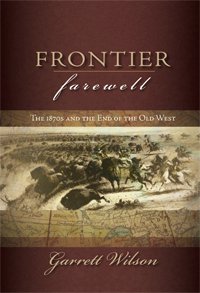
Frontier Farewell. The 1870s and the End of the Old West by Garrett Wilson Published by University of Regina Reviewed by Tim Tokaryk $19.95 ISBN 978-0-88977-193-2 The hoof prints have long since gone. The imprinted sand and clays quickly re-shaped by time, returned to a landscape dominated by natural grasses and sagebrush. But in cluttered archives and journal scrawlings their imprint remains. The impressions, ideas, hopes, and simple need for survival of the people of Canada’s West are newly amalgamated in Garrett Wilson’s Frontier Farewell, The 1870s and the End of the Old West. In this heavily researched volume, Wilson suggests that this period was pivotal to the shaping of the prairies and Canada as a nation. The Dominion of Canada, fearful of annexation by U.S. expansionismwas incensed in the marking of its territory, particularly along the seemingly arbitrary line of the 49th parallel: a line that didn’t follow any topographical relief or structure, a line determined in a country across an ocean. Despite what was decided in the mother land thousands of kilometers away or in the nation’s eastern capital, which seemed like another world in and of itself, the reality of determining the right course of action had…